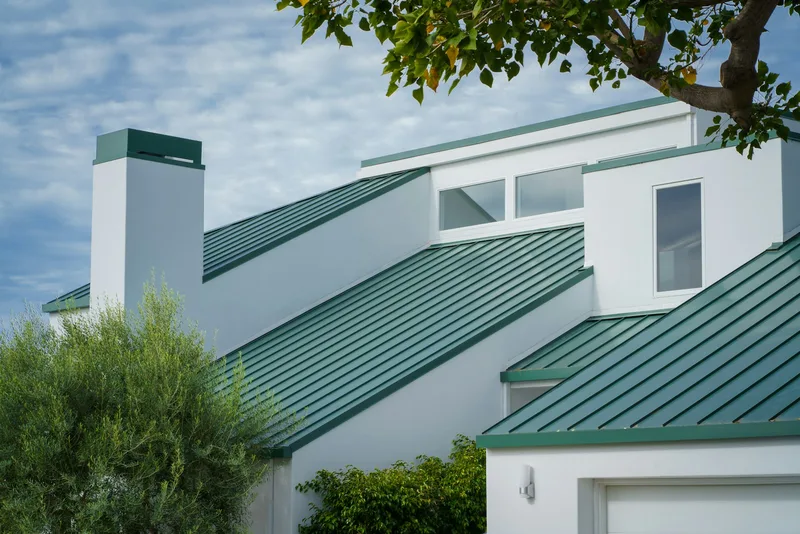
From the street, standing seam looks almost too simple: long, quiet lines running from eave to ridge, with no rows of screws breaking the surface. That simplicity is the point, and it is also a little misleading. The reason the system lasts is hidden inside those lines, in the way panels join, the way fasteners disappear, and the way the metal is allowed to move as temperatures change.
The clip is the whole idea
A standing seam panel is not screwed through its face. Instead, a clip grips the edge of the panel and is fastened to the deck beneath, and the next panel folds over the joint, hiding clip and fastener together inside a raised seam. The result is a roof surface with no exposed holes for rain, meltwater, or wind-driven snow to work on. Fewer holes mean fewer seals to age, fewer places for freeze-thaw movement to loosen a fastener, and fewer leak paths to chase twenty winters from now.
Thermal movement in a freeze-thaw city
Metal grows longer in summer sun and shorter in January cold, and a Fredericton roof lives through that cycle every year. Panels held rigidly by face screws fight the movement, which can oval out holes and wear down seals over time. Clips solve the problem by letting each panel slide a small amount as it expands and contracts, while the seam stays closed. Two seam styles do this job: snap-lock panels, which click together and suit steeper, simpler roofs, and mechanically seamed panels, which are folded shut with a seaming tool and hold tighter on lower slopes and in higher wind and snow exposure. Which one fits your roof depends on pitch, exposure, and panel length, and that choice belongs in the written scope.
Snow, meltwater, and the seam
The raised seam does quiet work in winter. It stands above the drainage plane, so meltwater runs down the panel channels instead of pooling on fastener heads, and snow releases more cleanly from a smooth, continuous surface. That shedding is a genuine benefit on the steep pitches found in Forest Hill, Nashwaaksis, and Southwood Park, but it also creates a planning duty: shed snow has to land somewhere safe. Snow guard installation should be mapped during design for any slope above a walkway, deck, driveway, or entrance, because retrofitting guards after the fact is rarely as clean.
Where the premium earns itself
Standing seam costs more than an exposed-fastener panel, and on some roofs that premium is money well spent. Long, simple roof runs let panels do what they do best, with few seams and fewer transitions. Lower-slope sections benefit from a mechanically seamed joint that stays watertight where a simpler profile would struggle. And heritage-era homes in Downtown Fredericton and Silverwood gain a crisp, updated roofline that suits brick and older detailing without a fussy look, while rural homes around Skyline Acres benefit from long, continuous panel runs. If you plan to stay in the home for decades, the concealed fasteners and long service life are the core of the case.
Where a simpler panel is the honest choice
There are roofs where a simpler panel is the smarter buy, and a trustworthy professional will say so. Garages, sheds, workshops, and cottages often do fine with a ribbed, exposed-fastener panel at a lower cost, provided fasteners are checked and maintained over the years. Very cut-up roofs with many small planes, dormers, and transitions can also erode the standing seam advantage, since seaming labour multiplies with every short run. And if the budget is tight, a well installed ribbed roof with good flashing and ventilation beats a standing seam roof installed on the cheap with corners cut at the details. The honest question is not which profile is best in the abstract, but which one fits your roof shape, your budget, and how long you plan to stay.
Standing seam in a full project
Most standing seam work arrives as part of a broader metal roof installation or metal roof replacement project, and the same care should extend to the details around the panels. Flashing at chimneys, skylights, walls, and valleys must be formed for movement rather than simply caulked, underlayment and ice protection at the eaves guard against ice dams, and attic ventilation protects the decking beneath. If you already have a standing seam roof, metal roof repair can address a damaged seam, flashing, or panel, and metal roof restoration can refresh an aging finish. Colour deserves daylight too: a shade that reads charcoal indoors can look blue or brown on a north-facing Fredericton slope in winter light, so ask to see larger samples on your own roof before deciding.
Cost, in honest terms
Standing seam generally sits above exposed-fastener panels in both material and labour, because panels are formed, clipped, and seamed more intensively, and the exact pricing depends on the full scope of work. Panel width, seam height, metal type, roof complexity, and site access all move the quote. Compare written quotes that describe the same seam system, profile, and detailing, not just a headline figure, and treat any quote that skips ventilation, flashing, or snow management as incomplete rather than cheap.
- Metal roof installation including standing seam systems
- Metal roof replacement from shingles or old metal to standing seam
- Metal roof repair for seams, flashing, and panels
- Snow guard installation for safe snow shedding
- Marysville and Uptown Fredericton homeowners, ask about standing seam for your roof shape
Questions, answered
Snap-lock panels click together and suit steeper, simpler roofs, while mechanically seamed panels are folded shut with a seaming tool for a tighter joint. The mechanically seamed option is usually the choice for lower slopes and higher wind and snow exposure.
No louder than other roofing in practice. Panels sit over decking and underlayment, and attic insulation absorbs most sound, so rain noise is rarely the issue homeowners expect. If noise worries you, ask your professional about underlayment and insulation options.
It can, within limits that depend on the profile and seam type. A mechanically seamed, double-lock system handles lower slopes better than snap-lock, and a local professional will measure your pitch and recommend a system suited to snow, melt, and drainage.